
Fishing-game shot costs: count accepted charges, not animated projectiles
Published — UTC

A burst animation can draw several projectiles after one control action. That visual count does not establish how many charged units the game accepted. To reconcile spending, use the unit named in the rules and the accepted transaction record.
Ten accepted charges, thirty drawn projectiles
Suppose a fictional history contains ten accepted shot records. Each costs 0.20 credit and each animation draws three projectiles. The stated billing unit in this example is one accepted shot record, not one drawn projectile.
| Field | Calculation | Total |
|---|---|---|
| Accepted shot records | 10 | 10 records |
| Animated projectiles | 10 × 3 | 30 images |
| Accepted cost | 10 × 0.20 | 2.00 credits |
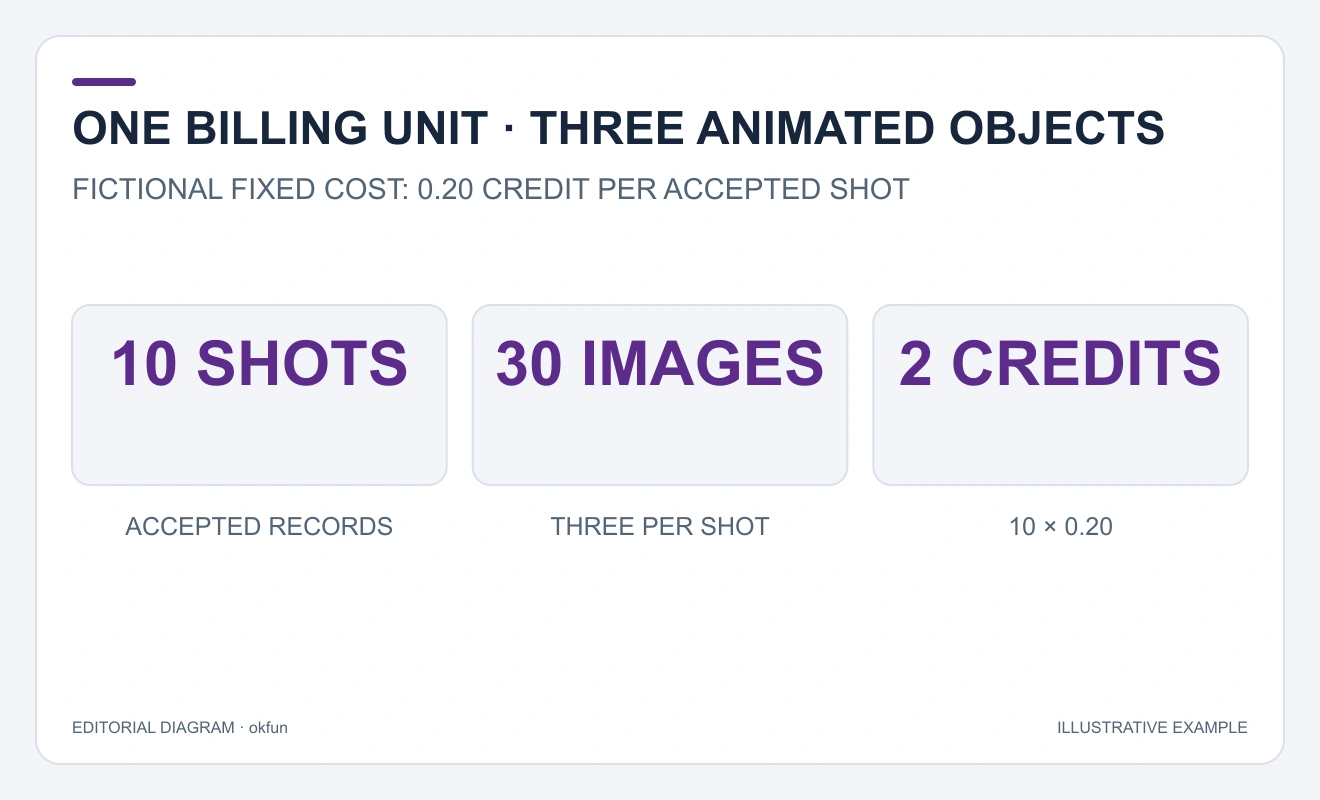
Multiplying 30 by 0.20 would produce 6.00 credits, but it would apply a record-level price to an animation-level count. The arithmetic is valid; the unit assignment is wrong. If another game explicitly charges per projectile, it needs a different record and calculation.
A change of weapon needs a new row
Now imagine eight accepted records at 0.20 and two at 0.50 after a mode change. The cost is 8 × 0.20 + 2 × 0.50 = 2.60 credits. Counting ten records at the first price would understate spending by 0.60. Counting projectiles still cannot repair that mistake.
Capture the weapon or mode, accepted unit price, record ID and currency or credit denomination for each segment. A tap that is rejected, repeated by the interface or awaiting acceptance should not silently become a settled shot.
What to compare when the totals disagree
First compare the accepted costs with the cost total in the same history range. Then inspect refunds or pending items separately. The British transaction-display reference distinguishes unit stake, total stake and credit conversion; its scope does not prove a particular fishing game follows this example.
Reconcile a short wallet example
Continue the mixed-price example with an opening balance of 20 credits and no awards, deposits or withdrawals. The ten accepted records cost 2.60, so the expected balance is 17.40. If a separate confirmed reversal returns 0.50 for one of those records, the balance becomes 17.90. Keep the original charge and its reversal linked; do not erase the record and also add the refund, which would undo the same cost twice.
Now suppose an eleventh tap is marked rejected and has no corresponding debit. It adds neither a charged shot nor a cost. If a debit exists despite that status, the mismatch remains unresolved until the transaction is identified. The word “rejected” alone is not permission to rewrite an account balance.
Credits need a conversion rule too
In another hypothetical configuration, one credit represents 0.10 currency unit. A cost of 2.60 credits then equals 0.26 currency unit. It does not equal 2.60 currency units. Record the conversion applying to the accepted event; a later screen denomination should not silently revalue older entries.
Prepare a useful discrepancy report
Use the smallest affected range: game and mode, accepted record IDs, price and unit for each record, opening and closing balances, plus linked reversals. Keep the animation count as a separate observation. This distinguishes a price change, a repeated visual and a missing account entry without assuming which explanation is correct.