
Big target, big reward: why is that still lacking in comparison fishing games?
The size of the possible reward and the chance of getting it are different information. If the capture condition, probability and cost are not known, do not use the number on the big fish as a value rating.
For the topic overview, see Does the feature-entry option cost extra?.

The bigger the boss is on the screen, the stronger the animation and the higher the award label. It’s understandable why that’s the first thing to notice. But those three things don’t say how often the award is given or what event is required. Even if the maximum is written clearly, there may still be insufficient data for comparison.
This guide comes with fishing format topic in okfun homepage. The own example below is made to show a reading error, not to pick a target to bet on.
“Chance” is not exactly probability
Officially JILI’s Royal Fishing overview, describes the energy that accumulates from shooting and a full-screen attack when it fills up. The summary also says that after defeating the Money Dragon King, there is a chance to activate the multiplier wheel that reaches 350×.
Those are two different specifications: condition before the wheel and a stated upper figure. In the summary text read on 4 October 2026, there is no exact probability of wheel activation or distribution of each wheel outcome. We don’t fill them in with boss size or a highlight video. The overview is not complete rules of the actual operator configuration.
If the target still needs to be defeated before another feature has a chance, “condition met,” “feature activated,” and “maxed out” are not the same thing. A single maximum label does not show that entire sequence of processes.
Own example: larger award, smaller average return
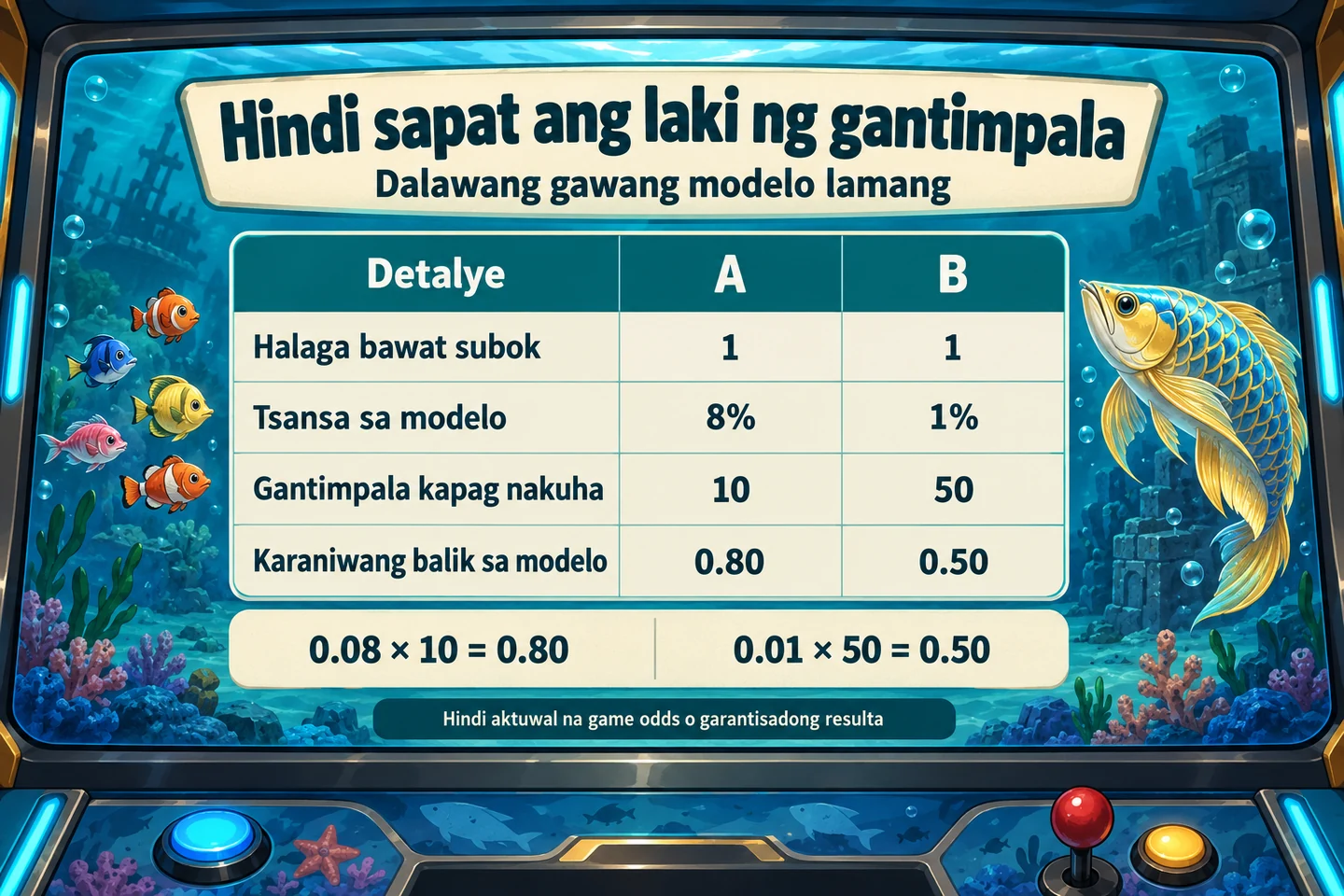
Think of two model made which are A and B. Each test is worth 1 unit. In each model there are 100 equally likely cards; a card is chosen at random and turned over before the next test. In A, eight cards have a reward of 10 units and 92 is zero. In B, one card has 50 units and 99 is zero. The award is total return; no separate returning stake.
The model is simplified to separate award from probability. This is not a description of the actual fish capture algorithm, and the 8% and 1% are not odds obtained from the provider.
| Detail | Model A | Model B |
|---|---|---|
| Cost per test | 1 unit | 1 unit |
| Cards with rewards / all cards | 8 / 100 | 1 / 100 |
| Probability in this model | 8% | 1% |
| Return when reward card is selected | 10 units | 50 units |
| Mathematical average return per test | 0.08 × 10 = 0.80 units | 0.01 × 50 = 0.50 units |
| Average net after deducting cost | 0.80 − 1 = −0.20 units | 0.50 − 1 = −0.50 units |
The reward of B is five times compared to A: 50 ÷ 10 = 5. However, its mathematical average return is smaller in the set condition. This is the reason why the award label is lacking in a comparison. In these two constructed models, both average returns are below cost; higher than 0.80 does not become a guaranteed profit.
It does not mean that 0.80 is actually obtained on a trial of A. The possible return in that model is 0 or 10. Nor does it mean that exactly eight rewards will appear in the next 100 trials: the card is returned, so any outcome can be repeated. The average is the result of a probability model, not a schedule of the next win.
If only the reward is known, leave the comparison unknown for now
If you delete 8% and 1% in the example, you lose the basis of 0.80 and 0.50. Probabilities cannot be returned from 10 and 50 only. Many possible probabilities can be paired with the same award.
So is the limit of a found maximum on the game page. Besides the possibility of getting that, a full list of other outcomes, the actual cost and the feature state may be needed. A possible reward is not a complete distribution, and a claim of “up to” is not an average return.
- Reward rules: is the award fixed, range, wheel outcome or only maximum? What is the unit and multiplier base?
- Qualifying events: is a hit enough, is a completed capture required, or is there another chance-based stage?
- Cost: how much is the confirmed action and is there a separate special-weapon charge? Do not assume the same in another setting.
- Probability evidence: is there applicable official data for the exact variant? If it doesn’t read, write “not specified in the source.”
- Confirmed result: match the award with the action or round record. This does not replace the size of the animation.
In UK Gambling Commission RTS 3, separately discussing the rules, information on the likelihood of winning and explanation of the payouts. This standard is in the scope of regulation in Great Britain; only reference here for different types of information, not certification of the site or law assumed for the Philippines.
How to make a useful note
Instead of “big fish, more worth,” write: “This source describes [award or maximum] after [condition]. [probability or cost detail] is not specified in the text read, so I did not calculate an expected return.” It is shorter than a rating, but easier to verify and correct when there is a new rules document.
If there is an account question, use the operator’s matching history and support. For the difference between component award and total return, there is a separate round-history topic. There is no need to take additional paid actions to fill a documentation gap.
Questions about reward and probability
Does a bigger target mean a better chance?
Nope. Visual size has no numerical probability in itself. Applicable rules and data are needed; capture chance cannot be taken from artwork.
When there are many consecutive no awards, is the reward near?
In our illustrative model with card replacement, previous draws do not change the probability of the next draw. This is not a claim about all game mechanics; actual state-dependent rules must be read separately.
Is Royal Fishing RTP 80% or 50% here?
Nope. These are ratios of the mathematical return to cost of own models A and B. We have not measured or reported RTP for Royal Fishing or an operator.
Naa guide library the other subject. Two official sources were checked on 4 October 2026; the card model and all probability calculations are proprietary and separate from the provider overview. For 21+ readers; this is a data limitation explanation, not a betting suggestion.