
Lottery pool shares: record ownership separately from the person who paid
The person who pays at the counter is not necessarily the sole owner of a group’s lottery entry. Equally, a payment into a group does not tell you the ownership percentage unless the group has defined how shares work.
For the topic overview, see Ticket identity and result screenshot.
For a clear record, separate the money collected, the entries included and each member’s agreed share. The arithmetic below illustrates that recordkeeping distinction; it does not establish a legally enforceable arrangement.

Define the unit being divided
The University of Greenwich paper on lottery syndicates discusses recording membership and equal or other shares in a UK context. Local legal and claim requirements need their own advice. Here we use a fictional, already-agreed share schedule solely to explain allocation.
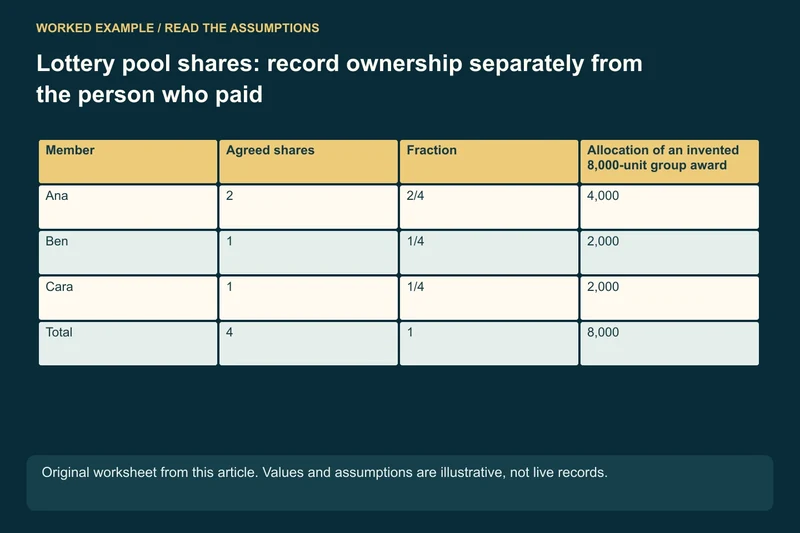
Assume a group has four equal shares for one specified draw: Ana owns two, Ben owns one and Cara owns one. The schedule applies to the identified group entries, not every ticket the organizer might buy personally.
Divide by shares, not by heads
| Member | Agreed shares | Fraction | Allocation of an invented 8,000-unit group award |
|---|---|---|---|
| Ana | 2 | 2/4 | 4,000 |
| Ben | 1 | 1/4 | 2,000 |
| Cara | 1 | 1/4 | 2,000 |
| Total | 4 | 1 | 8,000 |
There are three people but four shares. Dividing 8,000 by three would ignore the assumed ownership schedule. The check is that every fraction adds to one and every allocation adds back to 8,000. No extra award is created by the organizer holding the physical ticket.
Payment timing and ownership are different fields
Suppose Ana temporarily advances Ben’s contribution. That fact alone does not tell us whether Ana now owns Ben’s share, has made a loan, or has gifted the contribution. Those are different arrangements. A spreadsheet cannot choose among them from the payment amount.
Record the actual agreement before using it in an allocation. Keep the contribution status separate from the share count, and specify which draw and entries the schedule covers. Never rewrite ownership after seeing a result simply because a different split looks convenient.
A record should be checkable without exposing everyone’s details
For a private group record, retain the agreed schedule, entry references and a way for members to confirm the covered draw. Keep personal identification and claim documents out of a public example or shared screenshot.
This worksheet does not validate a ticket, settle a dispute or promise that an operator accepts group claims. It answers the narrower calculation: once the relevant award and valid share schedule are established, how is that amount allocated without confusing people, payments and shares?
The okfun homepage brings together the site’s other reading topics.
Source-based editorial research and original examples. Sources checked 9 October 2026. No real-money play or account transaction was performed for this article.
Related reading
Related reading
Lottery pool rounding: where does the leftover cent go? | okfun