
Lottery pool rounding: where does the leftover cent go?
Dividing a lottery pool into equal shares can produce fractions smaller than the amount your ledger can record. Rounding every share separately may make the payments add up to more or less than the pool. The difference needs a visible reconciliation, not an unexplained extra prize or a hidden deduction.
This worked example belongs to the okfun lottery section. It explains rounding after the amount and share schedule have been established. It does not determine who owns a ticket, validate a claim or prescribe a real operator’s settlement policy.
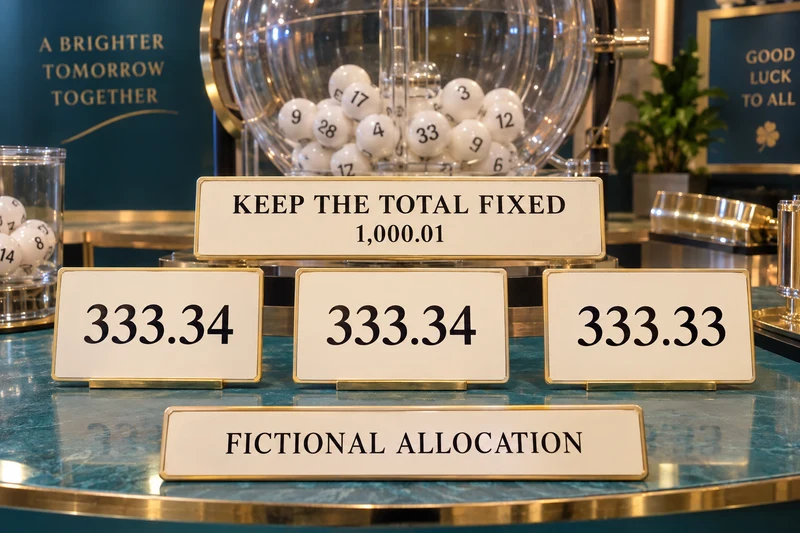
Start with one fixed amount and an agreed schedule
Assume a fictional group has exactly 1,000.01 units available for allocation and three equal shares, labelled S1, S2 and S3. Its ledger records amounts to two decimal places, so the smallest recorded unit is 0.01. No fees, taxes, further prize changes or other movements are included in this worksheet.
The unrounded mathematical share is 1,000.01 ÷ 3 = 333.336666… units. Writing 333.34 for each share looks reasonable, but three payments of 333.34 total 1,000.02. That is 0.01 more than the amount available. The division was not wrong; the three separate rounding decisions changed the total.
| Approach in the fictional example | Three recorded amounts | Total | Difference from 1,000.01 |
|---|---|---|---|
| Round each share to nearest 0.01 | 333.34 + 333.34 + 333.34 | 1,000.02 | 0.01 too much |
| Initially round each positive share down | 333.33 + 333.33 + 333.33 | 999.99 | 0.02 remains unallocated |
| Apply the stated remainder rule below | 333.34 + 333.34 + 333.33 | 1,000.01 | 0.00 |
Give the remainder its own line
For this example only, suppose the group has already agreed to start with each positive share rounded down to 0.01, then distribute remaining 0.01 units by largest fractional remainder. Ties follow a fixed share order recorded beforehand: S1, then S2, then S3. This is an illustrative allocation rule, not a claim about legal entitlement or an operator’s rules.
The initial three amounts total 999.99. Subtracting that from 1,000.01 leaves 0.02. All three exact shares have the same fractional remainder, so the stated tie rule gives an extra 0.01 to S1 and an extra 0.01 to S2. S3 keeps 333.33. The final amounts add back to the original 1,000.01.
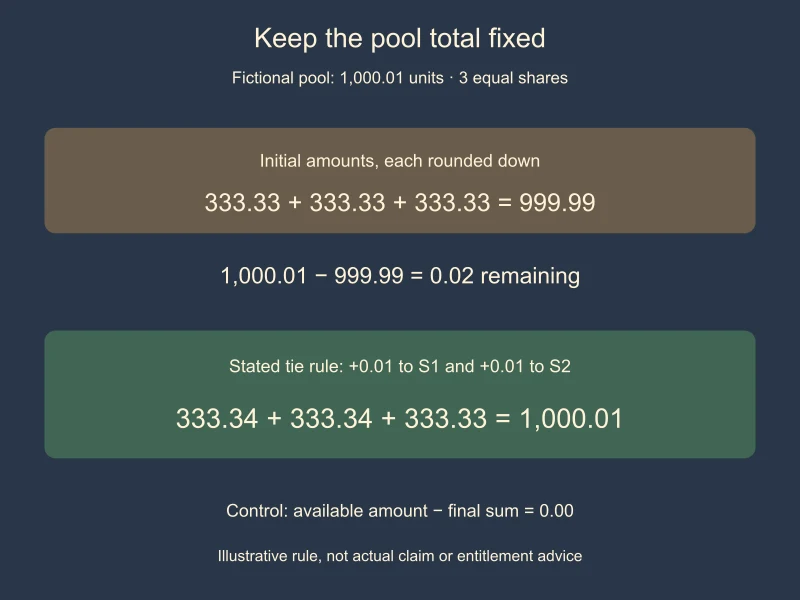
That adjustment is a reconciliation of the same fixed pool. It does not create two new prizes or permanently change any member’s one-third ownership. A different valid agreement may use another remainder method; the worksheet cannot choose one on a group’s behalf after seeing the money.
A spreadsheet can round correctly and still fail the total check
Microsoft’s ROUND documentation explains rounding to a specified number of digits. In this example, =ROUND(1000.01/3,2) returns 333.34. Copying that rounded amount into three payment rows gives the 1,000.02 total above. The function is doing its job, but it is not a complete allocation policy.
Keep separate columns for the exact fraction, the initial recorded amount, the remainder adjustment and the final amount. Then calculate a control value: amount available minus the sum of final allocations. Here the control must be 0.00. Display formatting alone is not the same as changing a cell’s stored value, so compare the actual recorded payment amounts.
Rounding cannot decide who owns the shares
The arithmetic starts only after the relevant pool and valid share schedule are known. If one person owns two shares and another owns one, three equal payment rows to three people would already be the wrong starting point. Read how to record ownership separately from the person who paid before using a rounding worksheet.
There is also a separate division between an announced jackpot and the portion allocated to a winning entry. The guide to a jackpot pool, winning entries and an individual share explains that earlier step. Do not use a cent adjustment to hide a wrong pool, an incorrect share count or a deduction that has not been established.
Leave a record that another member can follow
Write the draw and entries covered, the amount being allocated, the agreed share fractions, the smallest ledger unit and the remainder rule. Show the initial sum and every adjustment. If the amount changes, rerun the allocation for the revised amount and retain the previous version; adding an unexplained cent to an old row makes the record harder to check.
For this fictional example, the useful check is simple: 333.34 + 333.34 + 333.33 = 1,000.01. The extra cent on two rows is visible, the total stays fixed, and the assumed three equal shares remain documented. Source checked 10 October 2026; no actual pool, claim or payment was processed for the guide.