
GUIDE · okfun
A shared lottery jackpot: pool, winning entries and individual share
A jackpot headline can describe the amount available to a group of winners, rather than the amount paid to each one. To interpret it, find the pool, the sharing rule and the number of eligible winning entries. Dividing by the number of people mentioned in a story can give the wrong answer.
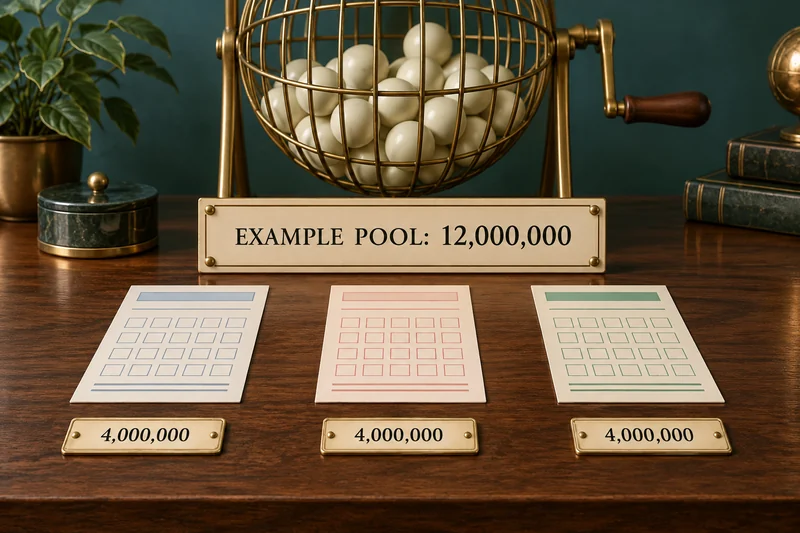
Sharing is a real distinction, but the figures below are invented
The PCSO 2022 annual report records 433 jackpot winners in the Grand Lotto 6/55 draw of 1 October 2022. That historical record illustrates why a jackpot need not belong to one winner. It is not today’s prize announcement, and we do not use it to establish current deductions or claim rules.
For a clear arithmetic example, assume a separate fictional lottery has a 12,000,000-unit pool and exactly three valid winning entries. Its stated rule gives every winning entry one equal share. All amounts below are before deductions, with no rounding complication.
Divide by eligible entries under the assumed rule
The share per winning entry is 12,000,000 ÷ 3 = 4,000,000 units. Three shares of 4,000,000 account for the whole pool. Describing each entry as receiving 12,000,000 would turn one pool into three and overstate the combined award.
Now suppose Holder A owns two of the three valid entries and Holder B owns the remaining one. The division still uses three entries:
| Holder | Winning entries | Allocation before deductions |
|---|---|---|
| A | 2 | 2 × 4,000,000 = 8,000,000 |
| B | 1 | 1 × 4,000,000 = 4,000,000 |
| Total | 3 | 12,000,000 |
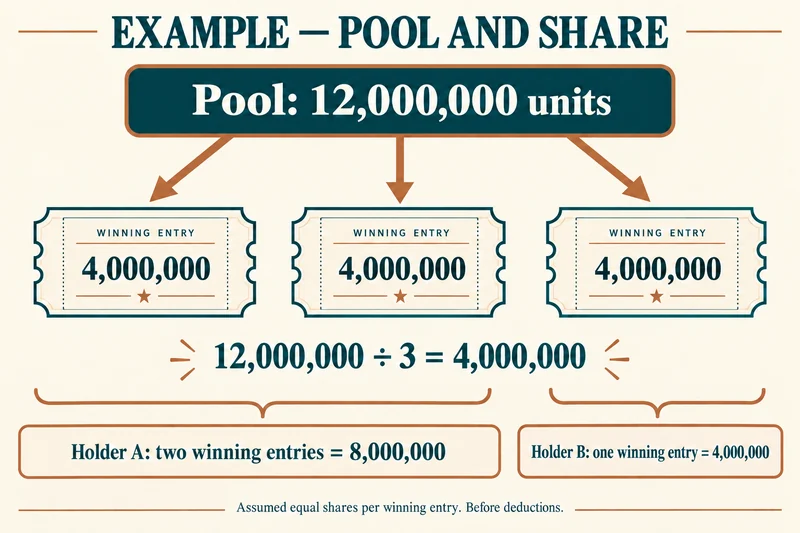
Dividing by two holders would incorrectly assign 6,000,000 to each in this model. Equal shares per entry are different from equal shares per person. A paper ticket may also contain more than one line; its physical count is not automatically the eligible-entry count.
A gross share is not yet a take-home amount
The 4,000,000 figure answers the allocation question under our assumptions. It does not answer what someone receives after any applicable deductions, how shared ownership is documented, or whether a claim is valid. Those questions need the actual product’s current terms and validation process.
If the announcement gives a pool but no final count of valid winning entries, the individual share is still unknown. An estimated counter is also a different record from a finalized award. Keep the label attached to the number instead of choosing the largest amount shown.
What to preserve when reading an announcement
Keep the product, draw date, currency, status of the amount and definition of a winning entry together. Then identify whether the source reports a pool, an entry share or a holder’s allocation. The example above is an accounting explanation, not a reason to buy duplicate entries or a forecast of return.
The lottery guide explains source and draw identity. If documenting a personal record, use the ticket-photo privacy guide before sharing a copy. Other topics are available on okfun.
Source-based editorial research and original examples. Sources checked 2026-10-08.
Related reading
Related reading
Lottery pool rounding: where does the leftover cent go? | okfun